A bag rustles in the hedge. Your horse spins, snorts and stares. Five minutes later, he still won't walk past that spot.
A spooky horse is not being difficult. He is environment-sensitive: he notices everything, and he reacts first. The good news is that trust can change how he responds.
Why a spooky horse reacts first
Horses are prey animals. Their eyes sit on the sides of the head. They see almost all around them. They are very sensitive to movement.
For a horse, every movement carries energy. And unknown energy means danger. You know a jogger in the forest is harmless — he doesn't.
Research suggests your horse is reading you, too. In a 2009 study, riders were told an umbrella would open as they passed. It never opened, but the riders' heart rates rose — and so did their horses'.
Another study, with 46 horses, found horses watch how a person reacts to something new. When the person seemed relaxed, horses stayed closer to the strange object.
Your horse should learn that you will never leave him in a dangerous situation.
Signs your horse is environment-sensitive
- Head up, ears locked on one spot
- Snorting, freezing or spinning away
- Spooking at the same place again and again
- Tension that builds on windy days or in new places
- Struggling to settle when there is movement around him
If he has become spooky suddenly, ask your vet to check him first. Discomfort or changes in his eyesight can make a horse less sure of the world.
What you can do: a common language and trust
Build a common language
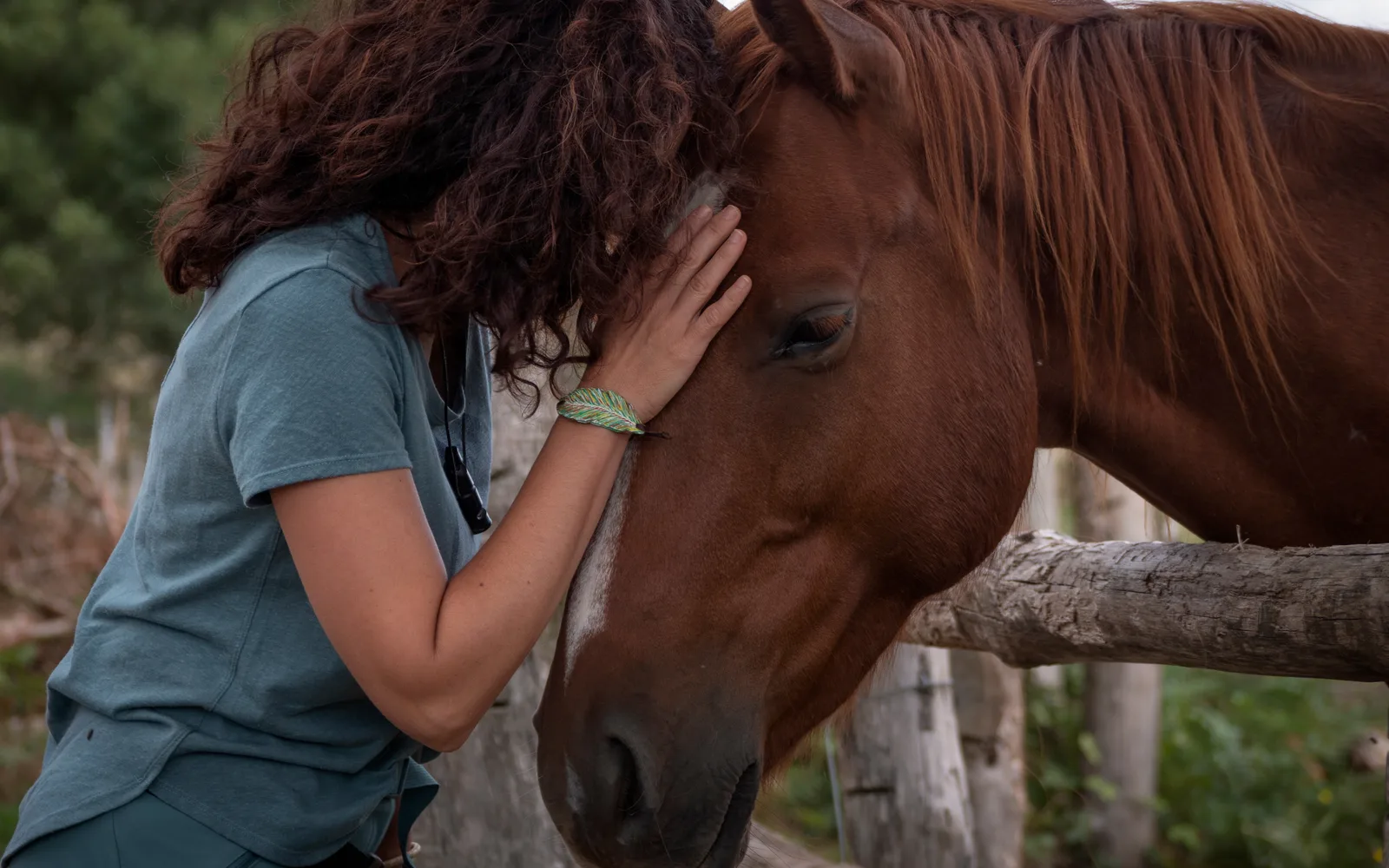
My common language with my horse is "with me". Whenever I say these words, I always breathe in, calm and slow. In the meanwhile, I bring his head to his shoulder.
Each part teaches him something:
- The common word: your horse learns what he needs to do.
- The breath: he learns a baseline for energy.
- The posture: by changing your horse's posture, you also help his body relax and settle himself.
Practise it when he is already calm, so it is ready when he needs it. Only ask him to bend as far as is comfortable for him.
Build trust — 360 degrees
Trust is 360 degrees. It includes being consistent in your breath, your energy level and how you handle him.
Your horse should learn that you will never leave him in a dangerous situation. So be aware of possible movement before he notices it.
You know what is danger. He doesn't. So identify strange movements and things before he notices them. Then guide him: it's ok.
Gradually, your horse learns that you have a better sense than him of what is dangerous.
Sometimes I hand-walk Billy, and I let him lead me in the front. When I see people moving in the distance in the forest, I already stop him first. Then I lead in the front. Then he knows. I always check the surroundings.
Allow him to turn back
A horse wants to turn back when he has doubts about what is in front. Don't push him to face the danger. Allow him to turn back a few steps to re-evaluate the situation.
Pushing him forward often pushes his energy even higher. Once he explodes, he will gallop back to the stable as fast as he can. Then he cannot hear anything from you any more.
When you allow him to turn back, he learns he doesn't need to react so much. He learns he can always step back to where he was — and it was safe. You still remain in control of him.
Then you evaluate the danger together. Yes, you know there is no danger. But work through it with him, slowly. Look carefully at what is in front. Take a few steps forward, then a few steps back again.
He will gradually relax. He knows that you know what bothers him. And he knows he can always step back. For the full step-by-step method, read the walk-back technique.
If your horse rears, bolts or becomes unsafe, stop. Get help from a qualified trainer.
How a holistic session can help
A horse who is always on alert often carries that tension in his body. In a holistic session, I combine energy work with massage, fascia release and gentle stretching. The aim is to help him relax and let go.
Usually you will notice changes about 24 hours later. The whole body needs time to adjust. Read more about restlessness and stress.
In my owner workshop, I teach simple energy and hands-on techniques for between sessions.
A spooky horse doesn't need to be braver on his own. He needs someone he can trust to notice first. That someone can be you.
Is your horse spooky or easily unsettled? Let's talk about your horse.