Your friend leads her horse out of the field. Yours starts calling. He runs the fence line, head high, sweat on his neck.
This is separation anxiety in horses. It is common, and it is not bad behaviour. Your horse is telling you he feels unsafe.
For a herd animal, being alone once meant danger. His nervous system reacts before he can think. The good news: calm can be learned — by him, and by you.
Why separation anxiety happens
Horses are prey animals. In the wild, a horse on his own is an easy target. Company means safety: more eyes, more ears, someone to share the watch.
Research suggests company really does calm horses. In a 2021 study, school horses reacted less to a new object with a companion nearby. It didn't matter whether the companion was a familiar friend or a stranger.
People may play a similar role. A 2025 study tested nine horses alone in a new place. With a calm person standing quietly nearby, their heart rate came down over time. Stress hormone levels didn't show the same effect, so the picture is not complete.
Your horse is not being difficult. He feels unsafe — and he is asking for help.
Signs of separation anxiety in your horse
You may see one sign, or several at once:
- Calling again and again for his friend
- Pacing, running the fence line or circling in the stable
- Sweating, a high head and wide eyes
- Not eating while he is alone
- Pawing, weaving or walking his box
- Pulling back to the gate, or rushing back to the herd when you ride out
Is the anxiety new, or suddenly worse? Ask your vet to take a look first. Discomfort in the body can make a horse feel much less safe.
What you can do today
Start with your own breath. Your horse reads your state the moment you arrive. Before you walk to him, take two minutes. Breathe out slowly, longer than you breathe in.
Higher energy against higher energy means explosion. If he is tense, lower your energy — don't match his.
Separate in tiny steps. Move him just a few metres away, where he can still see his friend. Stay there until he lowers his head or starts to eat. Then walk back together.
Next time, go a little further, or stay a little longer. Only move on when he is calm at the current step. Don't wait for panic before you stop.
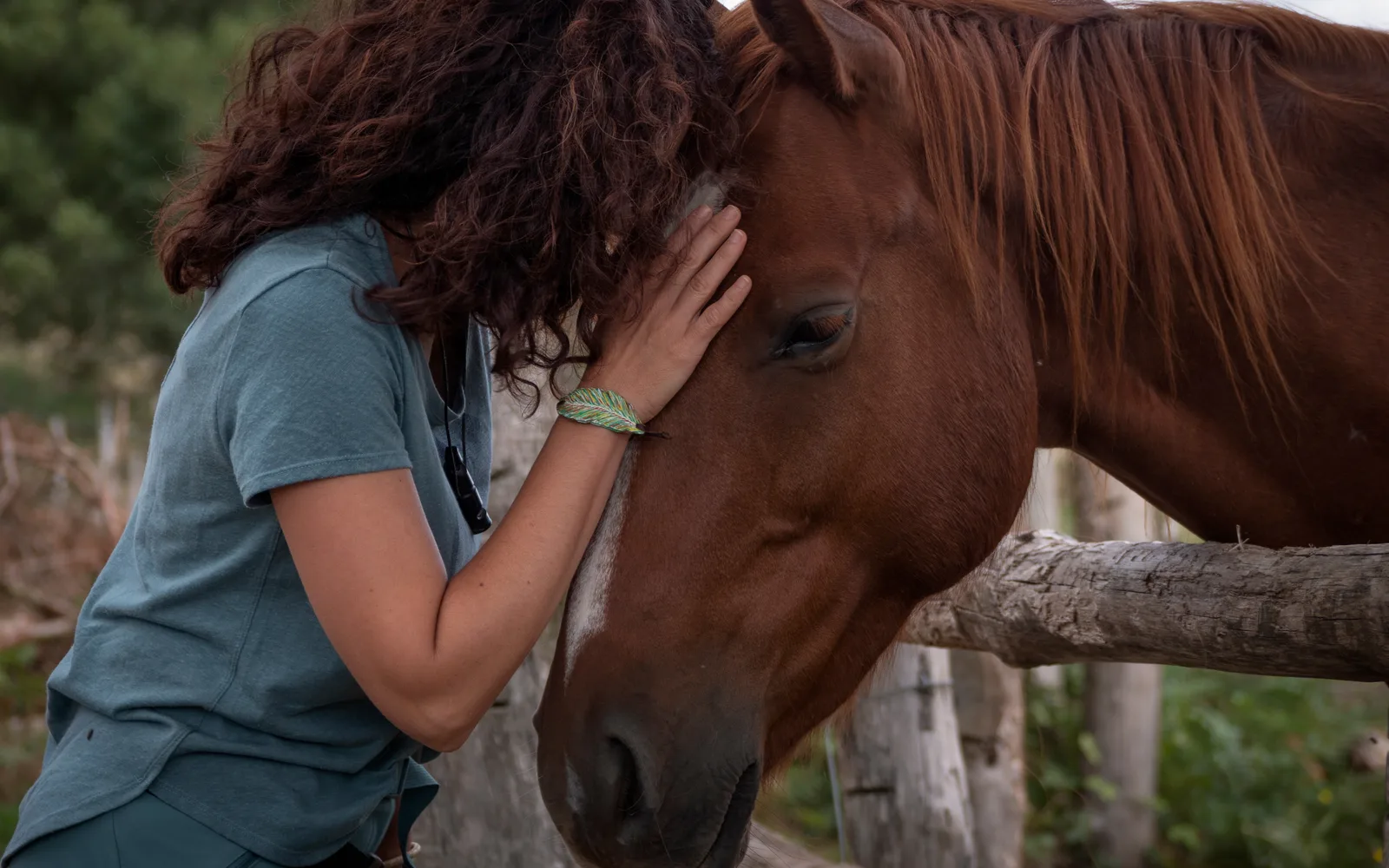
Be his calm companion. Stand beside him and breathe slowly. If he invites it, rest a soft hand on his neck or withers.
Watch for signs that he is letting go: a lowered head, licking and chewing, a long blow-out. When I sit quietly in a field, the herd often drifts over and dozes nearby. Calm spreads, and you can learn it.
Give him something to do. A hay net keeps his mind and mouth busy while he is apart.
Think about company. A horse who lives alone for long periods may struggle more. If that is your situation, consider a companion.
If your horse rears, bolts or becomes unsafe, stop. Get help from a qualified trainer.
How a holistic session can help
An anxious horse often carries his worry in his body, too. In a holistic session, I combine energy work with massage, fascia release and gentle stretching. The aim is simple: help your horse relax and let go.
Separation anxiety is not about one horse being "clingy". It is about a herd animal who doesn't yet feel safe on his own. Every calm minute you give him builds that safety.
Is your horse struggling when he's alone? Let's talk about your horse.