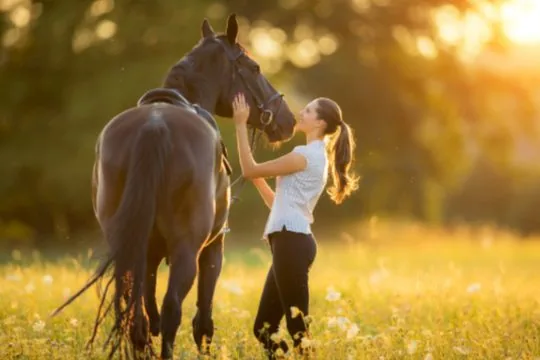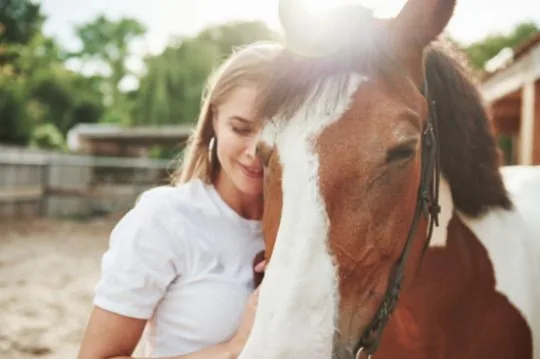
Your horse spooks at the same corner every ride. He won’t stand still for grooming. He loads fine on quiet days and becomes a different animal when you’re stressed. You’ve tried everything — different training, supplements, more turnout. And yet the tension keeps returning.
Here is the thing nobody told you: your horse has already noticed something. He is reading your nervous system, right now, with more precision than any instrument you own.
This is not only a poetic idea. Research is starting to measure it.
The Science: Your Hearts Are Already Talking
A 2024 study published in Scientific Reports used time-frequency analysis of heart rate variability (HRV) to map what happens physiologically when a human and horse interact. The finding was striking: bidirectional HRV synchronisation occurs between horses and humans, and the direction of influence shifts depending on who is leading the interaction — and how familiar they are with each other.
In plain language: when you are calm, your horse’s nervous system follows. When you are tense, the same thing happens in the opposite direction.
HRV — heart rate variability — is the measure of tiny fluctuations between heartbeats. A flexible, high-variability pattern indicates a nervous system that is regulated, adaptable, and capable of social engagement. A rigid, low-variability pattern signals stress and threat response. Research at the HeartMath Institute suggests that horses may detect the electromagnetic field generated by the human heart from over a metre away. They are not picking up on your body language alone. They are reading your field.
This is why I use the word coherence — not just calm. A coherent heart field is stable, rhythmic, and radiates out. A horse in proximity with a coherent human moves toward regulation. A horse near an incoherent, anxious human amplifies that state. It is not magic.
What Your Nervous Horse Is Actually Trying to Tell You
Before we talk about what to do, it is worth understanding what nervousness is in a horse.
Horses are prey animals. Their nervous system evolved to detect threat fast and react faster. Polyvagal theory — the neuroscience framework developed by Professor Stephen Porges — describes three nervous system states that apply as much to horses as to humans:
- Ventral vagal (safe and social): the horse is relaxed, curious, willing to engage. Ears soft, breathing deep, jaw loose.
- Sympathetic (fight or flight): the horse is alert, tense, ready to move. Eyes wide, muscles braced, breathing shallow.
- Dorsal vagal (shutdown): the horse has given up. Unresponsive, dull, disconnected. This is often mistaken for a “quiet” horse.
A nervous horse is usually in sympathetic activation — fight or flight is on. The critical point: a horse in this state cannot learn, cannot release tension, and cannot connect. You cannot train your way out of sympathetic activation. You can only offer safety.
Watch for these signs that your horse is stuck in threat response: reluctance to stand still, hypersensitivity to touch especially around the neck and back, tension in the jaw, tail swishing without flies, resistance to collection, and spooking at things that “shouldn’t” bother him.
These are not character flaws. They are a nervous system asking for help.
5 Things You Can Do Today — With Your Energy, Not More Equipment
1. Arrive before you arrive
Your horse registers your state the moment you walk through the gate. If you drive to the stable already rehearsing the argument you had at work, that is what he gets. Before you enter his space, take two minutes in the car park. Breathe out fully — longer exhale than inhale. This activates the parasympathetic nervous system and begins to shift your HRV toward coherence. You are preparing your field before you ask him to receive it.
2. Lower your energy first — always
“Higher energy against higher energy means explosion.” When your horse is anxious, our instinct is often to become bigger — louder, faster, more insistent. This is the worst thing we can do. Match your horse’s speed with slower movement. Match his tension with your own breath going softer. You are not surrendering. You are offering a frequency he can follow.
3. Use your voice before you use your hands
Voice is energy. It carries your nervous system state in its tone, its pace, its steadiness. When I first started working with Olivia — a pony with a difficult past who bit and kicked anyone who came near her — I did not touch her for two weeks. I simply visited her stall for three to five minutes a day and talked. About the weather. About whether she liked her hay. The words did not matter. What mattered was that she could feel my intentions through my voice, and that my energy was not a threat.
You can do this with any horse. Slow your speech. Drop your pitch slightly. Pause. Let your horse hear that nothing is about to happen — before anything happens.
4. Slow, intentional hand contact along the neck and back
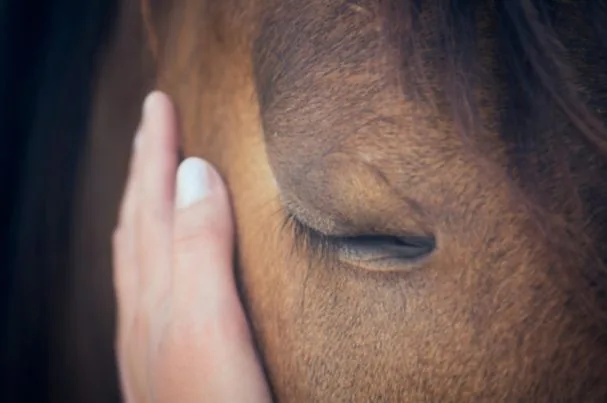
Research suggests what horse people have known for centuries: regular massage can lower cortisol and heart rate in horses. But the quality of touch matters as much as the location. Slow down until you are slower than you think necessary. Place your hand and breathe — let your exhale land in your palm. Your horse feels not just pressure, but your energy through contact. A grounded hand can help a horse let go, even without formal training in energy work.
Pay attention to where your horse braces, holds his breath, or turns to look at you. These are conversations.
5. Stop before he asks you to stop
One of the most effective things you can do with a nervous horse is end each interaction before he becomes anxious — not after. Each short, successful contact builds evidence in his nervous system: this is safe. Over time, the threshold for anxiety rises. This is how trust is built — not in one long session, but in many small moments that all end well.
When to Consider a Holistic Session
If your horse’s nervousness is persistent — if he has not been able to settle despite veterinary checks, management changes, and good consistent handling — there may be something deeper at work.
In the Qi view, persistent tension can have an energetic layer. In Chinese medicine, Qi (life energy) flows through meridians throughout the body. When Qi is blocked — through trauma, accumulated stress, or compensation patterns from pain — it shows as persistent anxiety, reactive behaviour, or tension that keeps returning after manual therapy releases it temporarily.
In a holistic session I combine energy work with massage, fascia release and stretching. Afterwards you will often see the horse yawn, blow out or become very still — and the body usually needs about 24 hours to adjust to its new condition.
Always consult your vet first. The Common Concerns page explains where a session can support and where your vet comes first.
Your Horse Is Not Difficult
Your horse is communicating. Nervousness, spooking, tension, reactive behaviour — these are a nervous system doing exactly what it evolved to do, in an environment that is asking it to do something else.
The good news: you already have what it takes to help. You have a nervous system of your own. You have a voice. You have breath. And now you know that these things reach your horse before any training tool does.
Start there.