Your horse is stiff when he comes out of the stable. On cold mornings, he walks carefully and slowly. His hindquarters look smaller than they used to.
Stiffness can have several causes, so start with your vet. But once you know it is arthritis, you may wonder what to do — rest him, or keep moving?
Why Rest Alone Is Often Not Enough
Degenerative joint disease — DJD, also called osteoarthritis or OA — is not just a joint problem. It is also a muscle problem.
When a joint hurts, the horse protects it. He shortens his stride and shifts his weight away from the pain. Over time, the muscles around that joint weaken from lack of use.
Here is the problem. Weak muscles cannot protect the joint. The joint has to carry more load on its own. More load means more pain. More pain means less movement. The muscles weaken further.
Rest alone can weaken the muscles that protect the joint. Gentle movement helps keep them working.
This is why many vets recommend controlled, gentle movement for horses with arthritis — but your vet decides what is right for your horse, especially during a flare-up. The movement is not just exercise. It is maintenance.
What the Tai Chi Walk Is
太極步 — the Tai Chi walk — comes from Tai Chi Chuan, the ancient Chinese health practice. It is a slow, deliberate stepping pattern. Each foot is placed with full intention. Weight shifts completely from one leg to the other. Nothing is rushed.
This is not ordinary slow walking. Each step is conscious. The horse — or person — must fully load one limb before the next foot lifts. This small difference changes everything.
From a Western science perspective, this controlled weight-shifting is exactly what an arthritic horse needs. A 2023 systematic review on Tai Chi for knee osteoarthritis found that slow, deliberate movement consistently reduces joint pain and stiffness, and improves physical function in humans — without the impact stress of faster exercise. We don't yet have the same research in horses, but the principle — slow, controlled loading — is similar. The slowness is not a limitation. It is the mechanism.
From a Chinese medicine perspective, joints are nourished by Qi and blood — the body's vital energy and circulation. When Qi stagnates — when energy becomes blocked — the joint grows stiff, cold, and painful. This is called Bi syndrome: obstruction in the channels that pass through the joints. In Chinese medicine, the Kidney meridian governs bones and connective tissue. Gentle, rhythmic movement keeps this energy flowing through those channels every day.
The slow walk works on both levels at once.
What It Looks Like in Practice
You do not need a special track or equipment. You need fifteen minutes and a calm, soft surface.
How to do the Tai Chi walk with your horse:
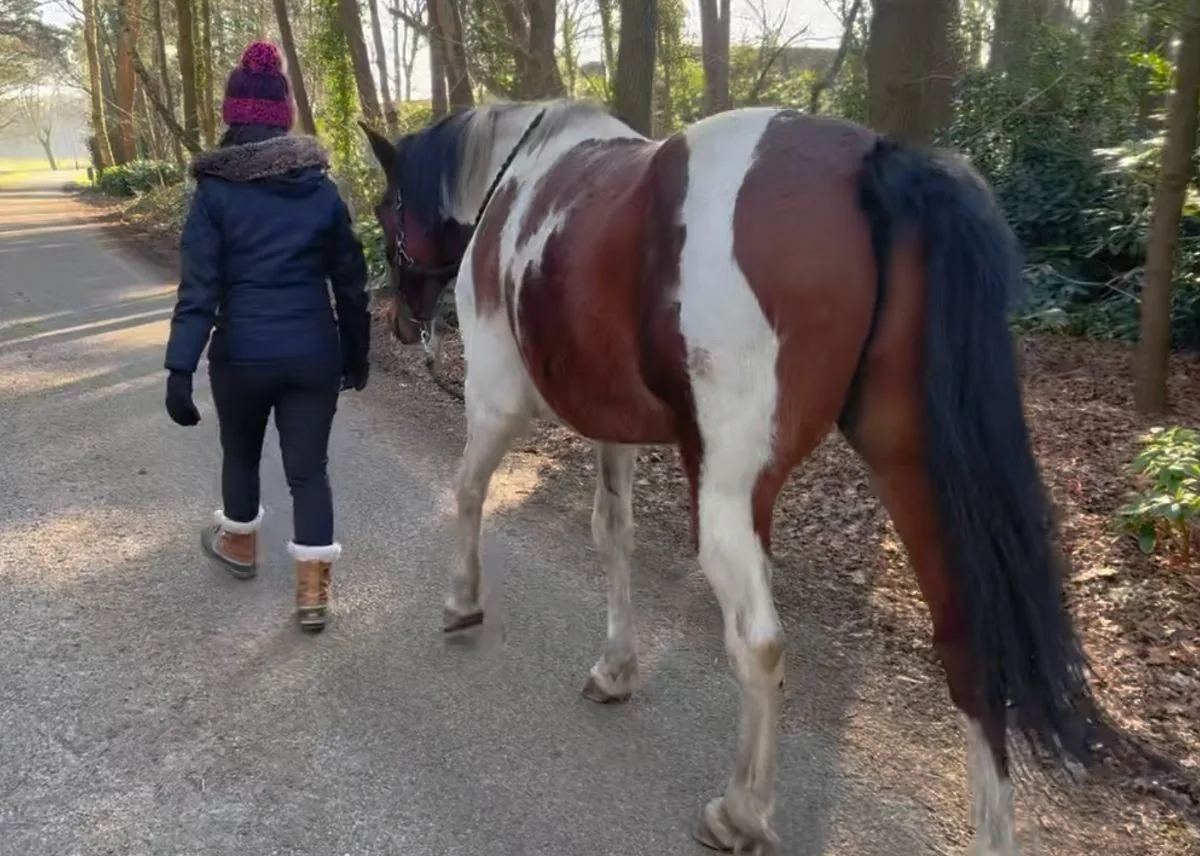
Lead your horse in a straight line at the slowest walk he can manage without stopping. Slower than he naturally wants to go. Allow each foot to land fully, load, and lift before the next one moves.
Keep to straight lines. Working on circles loads the inner and outer limbs unevenly — exactly what an arthritic horse does not need. Straight-line walking distributes load evenly and allows the fullest stride range for each leg.
Start with ten minutes a day. Build slowly to twenty minutes over several weeks. Daily consistency matters more than longer sessions done occasionally.
One more thing: your own energy matters. Stay calm, breathe slowly from your belly, and keep your own pace unhurried. A tense, rushing owner creates a tense, rushing horse. Your energy leads.
The Layer You May Not Have Considered
There is one more thing slow walking does that faster exercise cannot.
When you walk with your horse slowly and intentionally, with your full attention on him, you create something different. Research on HRV coherence — the synchronisation of heart rhythms between horse and human — suggests that a calm, present owner can help the horse's nervous system settle. Your nervous system speaks to his.
A stiff, uncomfortable horse often carries tension — in the body and, in the way I work, in the energy field. The Tai Chi walk — slow, rhythmic, conscious — creates conditions for that tension to soften. After five or ten minutes, you will often notice a blow-out, a head lowering, or a deepening of his breath. That is his body beginning to release.
The walk is a daily gift. Your calm presence is part of it.
If you would like holistic support for your arthritic horse — gentle massage, stretching within comfort, and energy work — I am happy to help. I work throughout the Netherlands.