Your horse used to flinch when you brushed a certain spot. Now he stands quietly. You tell yourself he is better. But something in you is not sure.
That quiet might not be healing. It might be something else entirely.
When Pain Stops Speaking
The nervous system is not a passive reporter. It adapts. When pain signals fire repeatedly over months or years, the brain begins to reorganise around them. Sometimes it amplifies — this is called central sensitisation, and it explains why some horses become hypersensitive to touch. But sometimes it does the opposite. The affected area goes quiet.
Neuroscience has a name for this: silent nociceptors. These are sensory neurons that simply stop responding to mechanical stimuli like pressure or touch. They are present in the tissue. They are still connected to the spinal cord. But they are no longer signalling. Research published in PNAS confirmed that these mechano-insensitive neurons make up a significant portion of deep somatic nociceptors — the ones innervating muscle, joint, and connective tissue. They can be reactivated by inflammation, but in a compensated, chronic state, they stay dormant. Most of this research comes from humans and laboratory animals, but it may help explain what we see in horses.
Chinese medicine described this centuries ago in different words. Acute problems are excess — blocked Qi creates heat, pressure, and noise. But when a blockage persists for years, the tissue transitions to deficiency. There is still no free flow. But the area is no longer full enough to protest loudly. In TCM, a deficient area is quiet not because it has healed, but because it has been depleted.
Two completely different frameworks that may describe the same thing: long-standing problems can go quiet.
What Silence Looks Like in Practice
When pain stops speaking directly, the body finds other ways to say it. Look for:
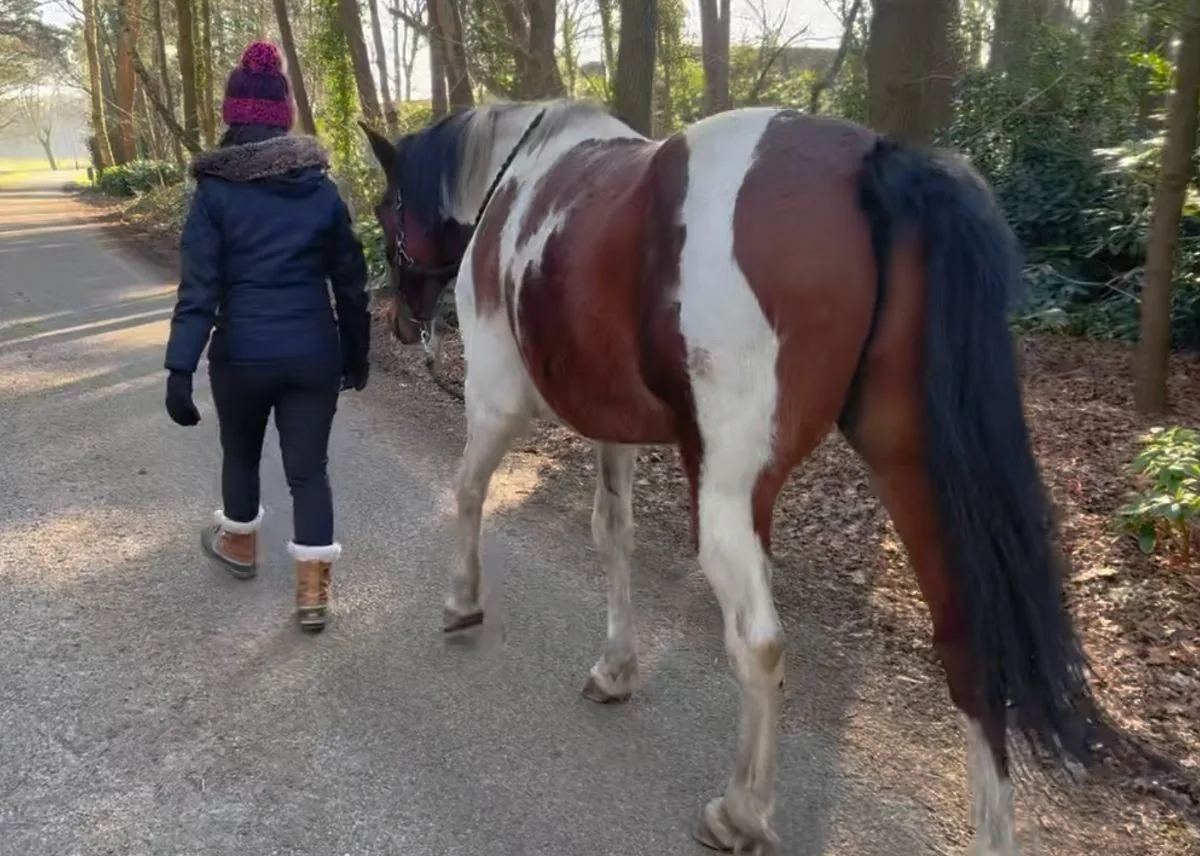
Postural shifts — a tilted pelvis, a tail that hangs consistently to one side, a topline that is higher on one side than the other. The body compensates for the area that stopped signalling by loading neighbouring muscles.
Movement asymmetry — a subtle preference for one rein, a reluctance to push off behind, a canter that feels good one direction and "just not quite right" the other.
No reaction where you expect one — a horse who used to lift his leg or flinch when you pressed the gluteal region, but now tolerates it without any response. Not necessarily because the tissue is healthy — the signal may simply have gone quiet.
Behaviour that looks unrelated — reluctance to load, girthiness that comes and goes, difficulty concentrating under saddle. The body's distress can show up elsewhere.
I saw this clearly with Billy, a horse whose crooked tail had gone unremarked for a long while. The tail itself was the last visible sentence — the body's posture saying what the pain system had stopped saying. When I worked the area with my palms, the energetic field there was notably absent. Not hot or congested as an acute problem would be. Empty. Flat. Read the full story in this post on the crooked tail.
How to Notice What Has Gone Quiet
This is where biofield scanning becomes practical. Energy practitioners often describe two different energetic signatures: acute areas feel warm, dense, or buzzing. Chronic compensated areas feel the opposite — cool, hollow, absent. The Qi has withdrawn from that region.
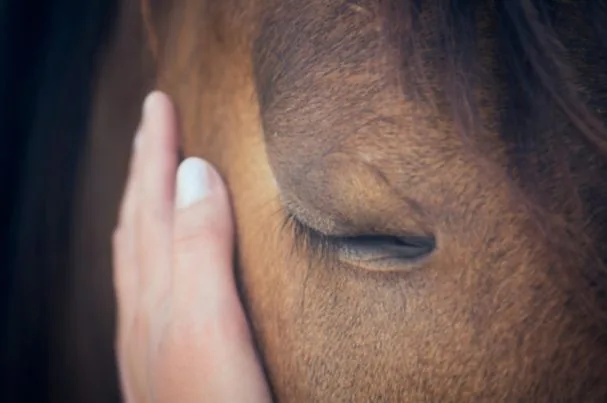
You do not need years of training to begin noticing this. Start by placing your palm a few centimetres above different areas of your horse's back and hindquarters. Move slowly. Notice where the sensation changes — not to make a diagnosis, but to develop your awareness. Your horse will often confirm what you find: a softer eye, eyes blink, a lowering of the head when you pause over the right spot.
These are confirmation signals. In my experience, they are the body beginning to respond.
What to Do When the Signs Are There
If the vet finds nothing structurally conclusive, or if physical treatment helps but the same problem keeps returning, a holistic session can be a complementary next step: gentle massage and fascia release for the muscles that have been compensating, and energy work for what, in the Qi view, is depletion rather than excess.
The horse that no longer screams may need you most. Silence is not the same as recovery.
Does your horse show signs of chronic compensation — a postural shift, uneven muscle, or a vague "something's off"? Get in touch to book a session. I offer holistic sessions — energy work and bodywork — throughout the Netherlands.