When did you last walk behind your horse to check if his tail hangs straight?
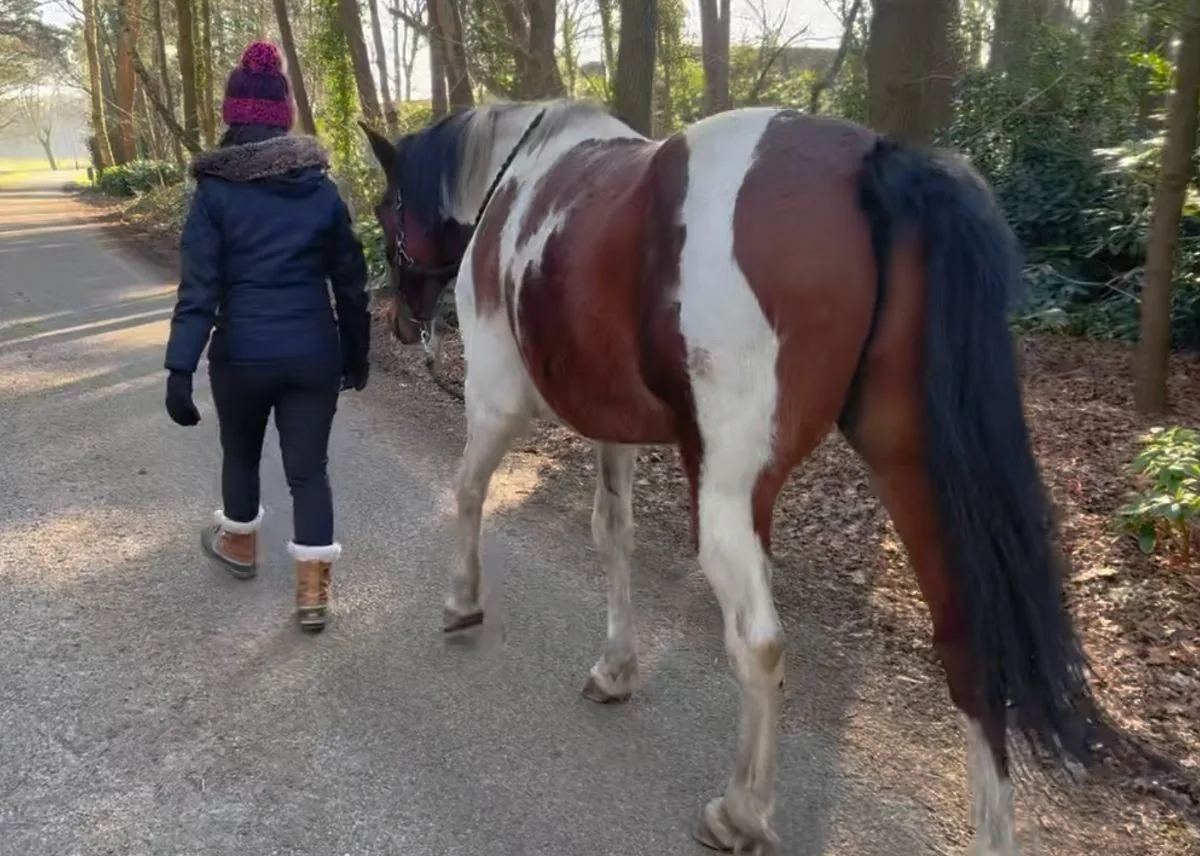
Most people never do. They notice a crooked tail when someone else points it out, or when riding starts to feel uneven and they cannot explain why. I found it by accident — my husband made a short video of me and Billy walking together, and when I watched it back, I saw it clearly for the first time. Billy's tail was not sitting in the centre.
It had probably been that way for a long time.
What a Crooked Tail Is Actually Telling You
A horse's tail position is not just cosmetic. It reflects what is happening deep in the hindquarters, pelvis, and lower back.
Veterinary literature describes a crooked or tilted tail as one possible sign of a problem at two locations. The first is the lumbosacral junction and sacroiliac (SI) joint — the hinge point where the spine meets the pelvis, and the most common source of hindquarter imbalance. Research published in veterinary clinical literature notes that horses with SI joint dysfunction will lock their tail to one side when asked to move in a serpentine. Vets may use this as one clue.
The second structure involved is the gluteus medius — the largest and most powerful muscle of the hindquarter, responsible for hip extension and forward propulsion. When the SI joint is blocked or painful, the gluteus medius on the affected side can tighten asymmetrically to compensate. Over time, that compensation pulls the pelvis — and the tail — off-centre.
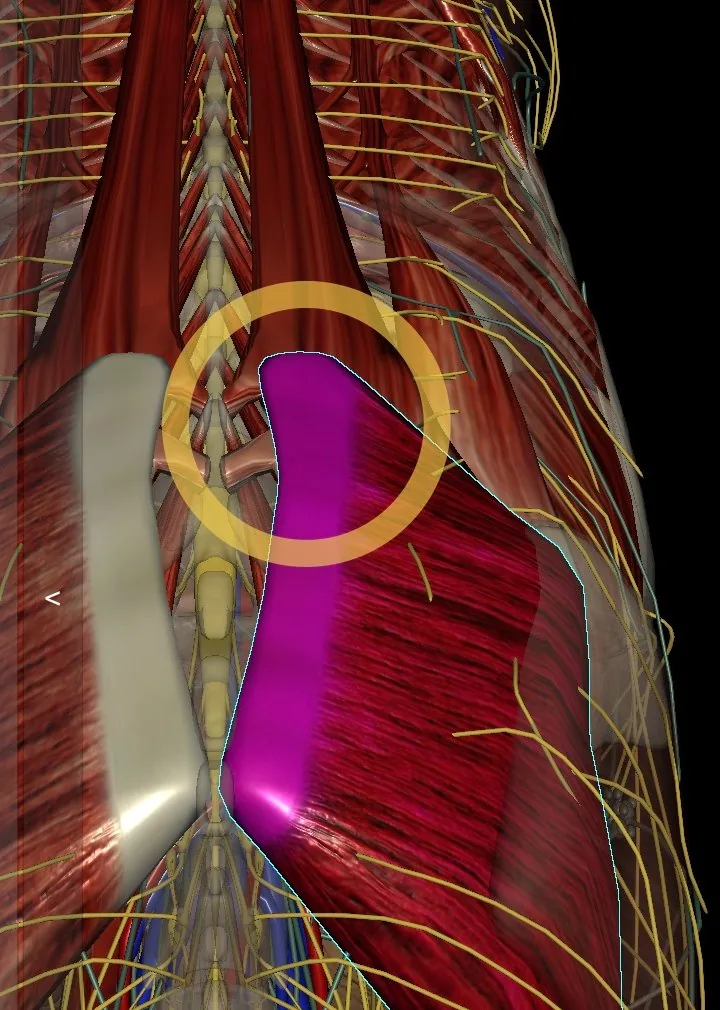
Two structures. One visible symptom.
What makes this tricky is that the compensation itself does not always hurt. The original blockage may have been present so long that the horse's body has simply adapted around it. He does not flinch. He does not protect it. He carries it as normal — and so the problem goes unnoticed.
When Chronic Blockage Goes Silent
Chronic issues sometimes stop emitting a pain signal. The body has compensated so thoroughly that the blocked area no longer speaks the way an acute problem does.
In energy terms, my palm — which I use to read the biofield and detect where Qi is disrupted — may not pick up a strong signal from an area that has been blocked for a long time. The energy there has gone quiet, not because the problem is resolved, but because the body has stopped trying to alert the system to it.
This means the evaluation has to be thorough. I cannot rely only on what my hands detect. I need to understand the horse's anatomy, map out all the areas that could be contributing to the symptom, and work through them systematically — even the ones that seem quiet.
With Billy, because we know each other well, this process becomes a kind of conversation. He understands from my body language what I am looking for. When I reached the area that was causing his tail to sit off-centre, he turned his head and looked back at me. His eyes said it clearly: yes, it's there.
The Release — and the Wait
Once I found the spot and focused my work there — energy work together with massage and fascia release around the hindquarters — something happened that I do not see often but that always signals a major shift: Billy seemed to receive an electrical shock that ran from his topline all the way up to his head. A visible, full-body wave of release.
In my experience, this kind of reaction happens when, in the Qi view, a long-held blockage releases at once. The energy that had been stuck suddenly flows again — and the body's response is immediate and unmistakeable. Billy began chewing and blowing out shortly after.
After the session, his tail had improved. But it was not yet fully straight.
This did not surprise me. My role is as an initiator — I work with what I find — with my hands and with energy — and the horse's body then takes its own time to adjust. And for a blockage this old and this deep, the body needed time.
The next morning I visited Billy again. His tail was perfectly centred.
I stood there for a moment, just looking at him. This is something I see often: the whole body needs about 24 hours to tune in to its new condition.
What to Look For in Your Own Horse
Walk behind your horse sometime this week — ideally on a flat, even surface, at a relaxed walk. Watch where his tail hangs. Is it centred? Does it swing evenly left and right? Or does it drift consistently to one side?
If you notice asymmetry, it is worth mentioning to your vet, particularly if you also notice any reluctance to engage the hindquarters, uneven muscle development on left and right, or difficulty with collection or lateral work.
If you have noticed a crooked tail or unexplained asymmetry in your horse, get in touch to book a session. I work throughout the Netherlands and always start by observing your horse carefully before a session begins.