You see your horse twisting his neck to bite at his flank. Or rubbing a specific spot on his leg against the stable wall. Or gnawing at a patch behind his shoulder he can just barely reach.
Your first thought: he’s itchy.
It might be. But in my experience, it can also be discomfort underneath.
Itch and Pain Share the Same Pathway
This is not just observation. There is science behind it.
Both itch and pain signals travel to the brain along the same nerve fibres — C-fibres — which is why the two sensations are so easily confused, even by the body itself. Scratching relieves an itch partly because the mild pain of scratching temporarily overrides the itch signal in the nervous system. The relief is real. But so is the discomfort underneath it.
For horses, this means that biting, rubbing, and scratching at a particular spot serves the same function whether the source is an insect bite or a deeper soreness. The body is trying to attend to a point of discomfort. The behaviour looks identical. The distinction is in how specific the horse is — and in what his face and body tell you.
What the Face Always Reveals
When I work with a horse who is biting or rubbing a particular area, I begin working at that exact point — with my hands, through gentle massage or fascia release, and with energy. And I watch the face.
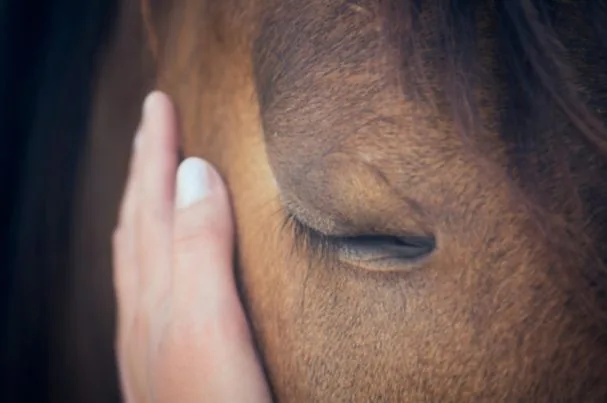
The response is often clear. The eyes soften. The jaw releases slightly. Sometimes the nostrils. The tension around the eye socket changes. The horse’s expression says, plainly: yes, that is the spot.
Science has a name for this. The Horse Grimace Scale, developed and validated in research from 2014 onwards, identifies six specific facial action units that change in response to pain — including tension around the eyes, strained nostrils, and changes in ear position. Researchers have found it to be a reliable, consistent tool for detecting pain in horses undergoing everything from castration to dental work to orthopaedic conditions.
Your horse’s face is an honest pain map. Relief is hard to hide. When you find the right spot, his face tells you immediately.
“Bad Behaviour” That Is Actually Pain Avoidance
There is another signal that gets misread even more often than biting and rubbing: the horse who moves away from your touch, pins his ears when you approach a certain area, or — if the sore point is on the leg or hindquarters — lifts his leg when you reach for it.
That leg coming up is not a threat. It is a sentence: do not touch there.
Horses cannot point to where it hurts. They cannot say “that spot on my left hindquarter has been sore for three weeks.” So they do the next best thing — they use their body to create distance between your hand and the pain. Moving away. Stepping sideways. Swishing the tail. Lifting the leg.
When we interpret these responses as disobedience or bad character, we miss everything they are trying to communicate. Worse, we often respond with more pressure — exactly the opposite of what the horse needs. In my experience, a horse who is labelled “difficult to handle” or “unpredictable near the hindquarters” often has a sore point in that area that is worth looking into.
The behaviour is not the problem. The behaviour is the message.
So when your horse reacts unusually to being touched somewhere — not just once, but consistently in the same place — treat that reaction as information. Slow down. Notice exactly where your hand was at the moment of the reaction. Go back there gently. Watch the face. And listen.
Why We Miss It
We talk ourselves out of it. “He’s always done that.” “It’s probably just the flies.” “The vet didn’t find anything.”
Some discomfort is subtle and doesn’t show clearly on every test. In the Qi view, there can also be an energetic layer. The horse still knows it is there, which is why he keeps returning to it.
When a horse bites, rubs, or reacts to touch at the same spot consistently, that is not random. That is information. His body is trying to address something, and it has been trying for a while.
The Relief Signs
After a session, you will see the horse release. He may yawn — a deep, jaw-stretching yawn that looks almost exaggerated. He may blow out slowly through the nose. His topline softens. He may lower his head and stand very still for a moment, processing.
These are not coincidences. They are the nervous system completing a stress cycle that had been held open.
In my experience, this is how you know the horse is letting go. Not because the horse tells you in words — but because his whole body changes.
What You Can Do
The next time your horse bites a spot, rubs persistently, or reacts when you touch a certain area, resist the automatic assumption that it is nothing — or that he is being difficult.
Note exactly where the spot is. Note how consistently he returns to it. When you groom him, slow down at that area. Pay attention to whether he leans in, moves away, holds his breath, or changes expression. These are not random reactions. They are a very specific kind of conversation.
Your horse is already telling you where he feels uncomfortable. You just need to know how to listen.