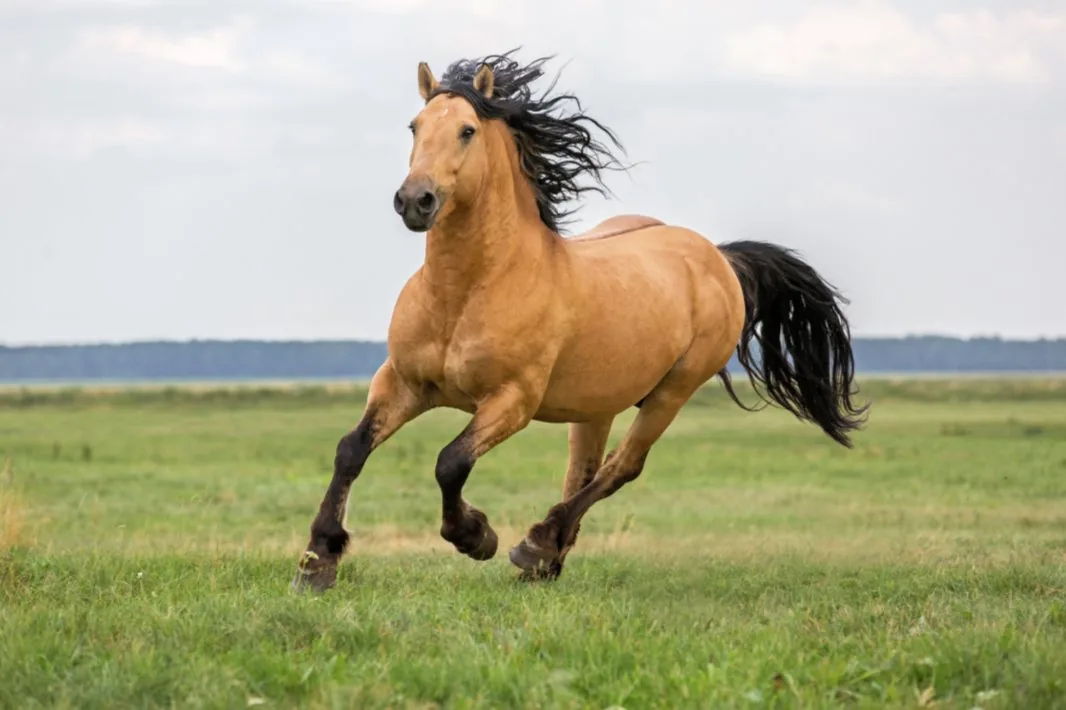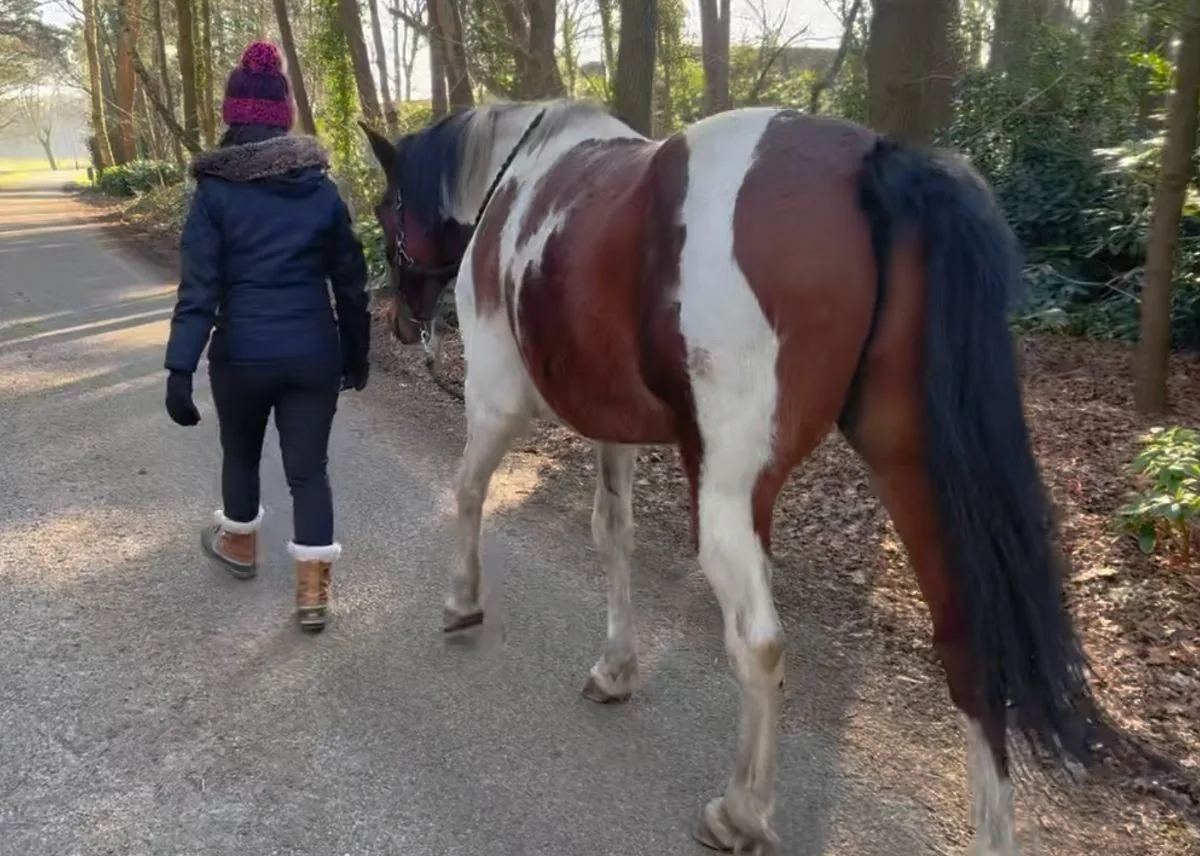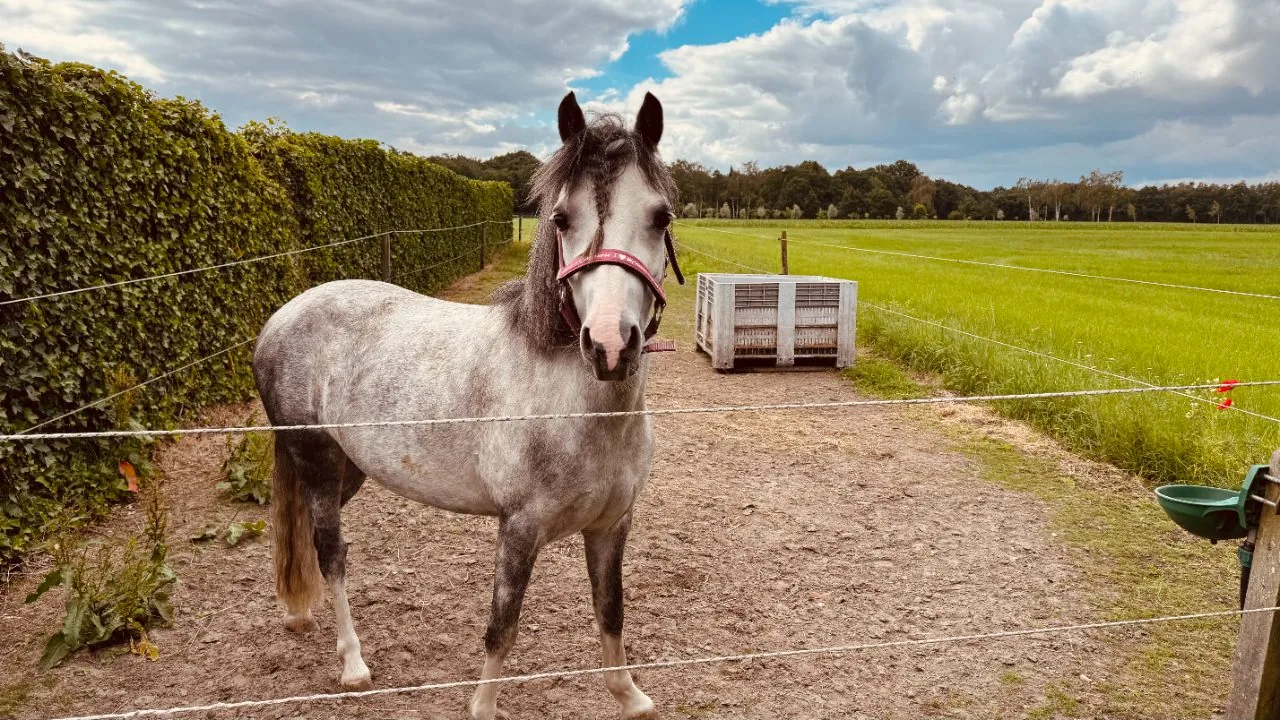
Have you ever been girthing your horse — quietly, carefully — and received a warning bite from nowhere? You jump back. Your horse goes calm again. You tell yourself he is just a bit naughty. He does not really mean it.
Maybe he just does not like being girthed.
I had this experience with Opium, a stable horse I rode regularly. He was the most gentle, easy-going horse in the stable. A pleasure to ride. The only thing you had to watch was the moment you reached for the girth. The snap would come fast, and then it was over. I was new to horses then. I assumed it was just his way.
It was not until Olivia that I understood what that bite was actually saying.
What a Girthing Bite Is Actually Saying
Girth aversion — biting, pinning ears, swinging the head, tensing the belly — is one of the most commonly misread behaviours in horses. Owners and riders often label it as temperament. Veterinary and equine behaviour research suggests a different story.
The girthing area is more complex than it looks. Four muscle groups converge here:
- The deep pectoral muscle — the large chest muscle that runs directly through the girth groove
- The serratus ventralis — the muscle that literally suspends the horse's ribcage between the front legs, bearing the weight of the internal organs and the rider continuously
- The external intercostal muscles — running between each rib, directly under the girth
- The levatores costarum — the rib-lifting muscles linked to breathing
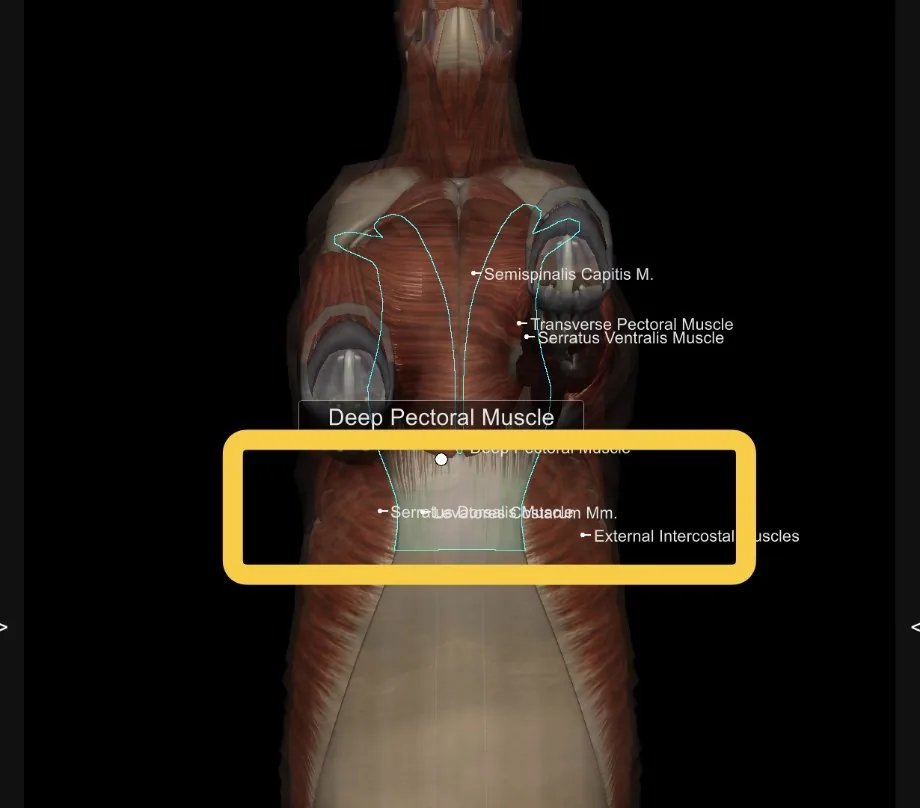
This region is under constant load. The serratus ventralis never fully rests — it holds the thorax suspended at all times. Add saddle and girth pressure on top of that, day after day, and the deep pectoral and intercostal muscles can develop what equine myofascial research calls trigger points: localised zones of muscle hyperirritability that refer pain and cause a protective response to any touch nearby.
The tension builds slowly. Then one day, it becomes untouchable.
Protection behaviour is not bad character. It is a message.
Olivia's Story
Olivia had already come a long way. From a difficult, defensive pony to a genuinely sweet girl — that transformation had taken months of patient work. But one thing had not changed: the girthing area was untouchable. Not for brushing. Certainly not for girthing.
Her owner had done everything right. A vet check — nothing found. Supplements to support joint and muscle health. The problem persisted. By the time her owner went on holiday and I came to care for Olivia, more than eight months had passed. Olivia was still in pain.
Her owner had given me open permission to help Olivia however I saw fit. So I tried to work on the girthing area. Olivia made her position very clear: warning bite, step away, do not come closer.
I tried several approaches. And when I brought my palm close — without touching — I detected something I was not expecting. A very strong, active signal from that area. Hot, almost electrical. In the way I read energy, this felt like acute, unresolved tension — excess Qi with nowhere to go. It was still loud after eight months, because Olivia's defensive behaviour had kept anyone from getting near it.
Given her history, I decided to work at a distance — no hands on the girthing area. I worked with energy from beside her, without any physical contact near the area.
Within five to ten minutes, something shifted. The tense, defensive posture softened. Then came the release: a long, continuous blow-out. A very big release. Then she settled into quiet chewing.
But she still would not let me touch the area.
This did not surprise me. Something had clearly shifted — but the memory of the old discomfort was still present in her nervous system. Research on pain and the nervous system suggests that the brain can retain protective reflexes long after the physical source has been resolved. The nervous system needs time to receive the message that the threat has passed.
I let her be.
The Next Morning
When I came back to the stable the following day, Olivia let me touch her everywhere.
As I see so often, the body needed time to adjust — about a day — before the change showed. Her protective reflex had softened, and her body was no longer on guard. I stood there smiling.
When her owner returned from holiday, she noticed immediately. Olivia was easy to brush, easy to girth, no biting, no tension. Her owner kept her vet informed, and together they decided to watch how Olivia got on.
A lot of horses carry tension in the chest and girthing area. It builds slowly, quietly, until one day it becomes untouchable. Next time your horse gives you that warning bite, do not dismiss it as naughtiness. Ask what is bothering him. There is often an answer — you just have to listen in the right way.
In a session, when the horse allows it, I combine energy work with gentle massage and fascia work around the chest and girth area — always at the horse's pace. Read more about my holistic method.
Does your horse show tension or defensiveness in the girthing area? Get in touch to book a session. I work throughout the Netherlands.